
Walking into a motorcycle dealership can be intimidating. You find the perfect bike, the engine note is just right, but then comes the question you aren’t ready for: “What’s your budget?” There’s a much better way to handle motorcycle financing. Getting pre-approved before you ever set foot on the showroom floor flips the entire script, putting you in the driver’s seat of the negotiation from the very start.
Motorcycle pre-approval is a conditional loan commitment from a lender who has actually verified your income and credit. Think of it like getting a firm budget before you go grocery shopping. The lender provides a formal letter stating that, pending final details, they are prepared to lend you a specific amount (say, up to $12,000) at an estimated interest rate. You now have a concrete price ceiling to work with.
In practice, this commitment transforms you from a casual window shopper into a serious buyer with the power of a cash offer. The benefits of bike loan pre-approval are immediate: it allows you to negotiate on the bike’s price, not your ability to pay. Instead of wondering if you’ll be approved, you can focus on the one thing that matters finding the perfect ride for the open road.
Prequalification vs. Pre-Approval: Why the Difference Matters
When you start exploring your financing options, you’ll hear two key terms: pre-qualification and pre-approval. While they sound similar, one is a casual estimate, and the other is a powerful negotiating tool. Understanding the difference between motorcycle loan prequalification vs. preapproval is the first step to shopping like a pro.
Think of a pre-qualification as a quick, informal guess. You provide some basic financial info, and a lender gives you a ballpark figure of what you might be able to borrow. To do this, they typically use a soft credit pull, which is just a quick peek at your credit history that does not affect your score. It’s like glancing at a restaurant’s menu online it gives you an idea, but it doesn’t reserve you a table.
A pre-approval, on the other hand, is a conditional commitment from a lender to give you a loan up to a certain amount. For this, the lender will verify your income and perform a hard credit pull, which is a formal credit check that can temporarily dip your score by a few points. This answers the common question, “does getting pre-approved hurt your credit?” While there’s a small, short-term impact, multiple hard pulls for the same type of loan within a few weeks are often treated as one, allowing you to shop for the best rates without worry.
A pre-qualification gives you a loose budget, but a pre-approval letter is what gives you real bargaining power. It proves to the dealership that you are a serious buyer with financing already secured. This shifts the negotiation in your favor, turning you from a window-shopper into someone they treat like a cash buyer.
Step 1: Check Your Credit Score Before Lenders Do
Before a lender approves you for a loan, they need to know you’re likely to pay it back. Their fastest way to gauge this is by looking at your credit score. Think of it as a financial trust score a single number that summarizes your history of handling credit and debt. Knowing this number is the first step in understanding what credit score for motorcycle financing you might need.
This three digit score, most often a FICO score, typically ranges from 300 to 850. A higher score tells lenders you’re a lower-risk borrower, which usually means you get offered a better interest rate. While every lender is different, here’s a general guide:
- 720 and above: Excellent/Very Good
- 680 to 719: Good
- 620 to 679: Fair
- Below 620: Needs Improvement
The good news is you don’t have to guess what your score is. You can often check your credit score for a loan application for free, and doing so won’t affect it. Common places to look include your credit card provider’s website, your bank’s online portal, or through free credit monitoring services. Once you have an idea of your credit standing, you’re ready for the next step: getting your paperwork in order.
Step 2: Gather Your Documents for a Smooth Application
Think of the loan application as an open-book test where you can bring all the answers. Lenders just need to verify the information you provide, and having the right documents needed for a motorcycle loan application ready beforehand makes the process faster and far less stressful. Instead of scrambling to find paperwork later, you can submit everything at once and get a decision sooner.
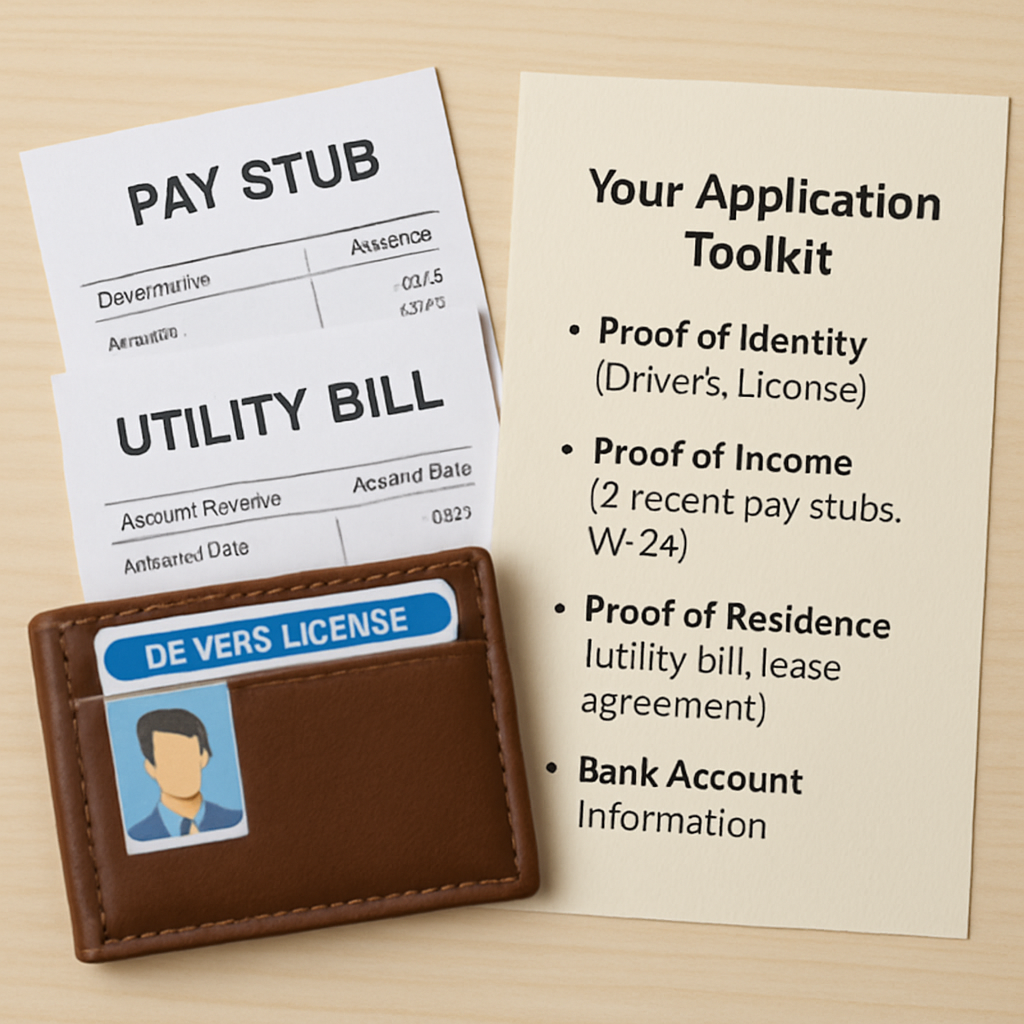
Lenders essentially need to confirm three things: who you are, how much you earn, and where you live. To make this easy, assemble a small “application toolkit” before you start filling out forms. This preparation shows you’re an organized and serious applicant.
Here’s what to bring for a loan application:
- Proof of Identity: A copy of your valid driver’s license or other government-issued ID.
- Proof of Income: Your two most recent pay stubs are standard. It’s also wise to have your latest W-2 the year-end wage summary from your employer—handy.
- Proof of Residence: A recent utility bill (like electric or water) or a copy of your lease agreement with your name and address on it.
- Bank Account Information: For setting up payments.
With this simple toolkit packed and ready, you have everything you need to confidently approach a lender.
Image: A simple, clean photo of a person’s wallet next to a pay stub and a utility bill on a desk, representing the necessary documents.
Step 3: Where to Get Pre-Approved: Banks, Credit Unions, and Dealerships
With your financial toolkit ready, you face your first big decision: who should you ask for the loan? Deciding on the best lenders for motorcycle loans often comes down to a choice between three main players: your bank, a local credit union, or the financing department at the motorcycle dealership itself. Each has its own set of pros and cons, and knowing them upfront can save you significant money and stress.
Many riders start with a bank or a credit union. Banks are familiar and convenient, but credit unions often hold a key advantage. Because they are non profit institutions owned by their members, credit unions typically pass their earnings back to you in the form of lower interest rates on loans. The only catch is you usually need to become a member, which is often as simple as opening a savings account. Getting an offer from one of these institutions gives you a powerful baseline before you ever step into a showroom.
On the other hand, there’s in-house dealership financing, which offers undeniable convenience. You find the bike you love, and the salesperson handles all the loan paperwork for you right there brands like Harley-Davidson even have their own dedicated financing application process. While this is a tempting one-stop shop, it puts you at a disadvantage. Without a competing offer in your back pocket, you have no way of knowing if the rate they offer is truly competitive. This is the core difference when comparing dealership financing vs. a credit union for bikes; one offers convenience, the other offers leverage.
Ultimately, your goal is to walk into the dealership with the power of choice. By securing a pre-approval from a bank or credit union first, you can focus on negotiating the price of the motorcycle, not the terms of the loan. This naturally raises a common question about how lenders check your credit.
Will Shopping for a Loan Hurt My Credit Score? The Truth About “Hard Pulls”
It’s a fair question that holds many people back: does getting pre-approved at multiple places hurt your credit? The short answer is yes, but only a little, and in a way that’s designed to help you. When you formally apply for a loan, the lender performs a “hard pull” on your credit, which is an official review of your financial history. This action can cause your score to dip by a few points, but it’s not the whole story.
Fortunately, credit scoring models are smart. They understand that you’re not trying to open five different motorcycle loans but rather shopping for the single best one. Because of this, these models typically treat all hard pulls for the same type of loan (like an auto or motorcycle loan) within a specific rate shopping window as just one single inquiry. This window is usually between 14 and 45 days, depending on the scoring model being used.
The bottom line is clear: you absolutely can and should shop around for the best motorcycle loan rate. As long as you submit your applications within a couple of weeks, the impact on your credit will be minimal. This strategy ensures you find the most affordable path to your new bike. Of course, this process is smoothest with good credit, but what if your score isn’t perfect?
Getting a Motorcycle Loan with Bad Credit: A Realistic Plan
What if your credit score is lower than you’d like? Don’t assume you’re out of the running for a new bike. While getting a motorcycle loan with bad credit presents a few more hurdles, it’s often still possible if you approach it with the right strategy. Lenders view a lower score as higher risk, but you can take specific steps to lower that risk and boost your chances of approval.
One of the most powerful tools you have is a larger down payment. By paying more cash upfront, you reduce the total amount you need to borrow. For a lender, a smaller loan is a safer loan. For example, on a $9,000 motorcycle, putting down $2,500 instead of just $500 shows you have skin in the game and dramatically lowers the lender’s potential loss, making them much more likely to say yes.
Another common path for bad credit bike financing is finding a co-signer. A motorcycle loan co-signer is someone with a strong credit history, typically a family member or trusted friend, who agrees to sign the loan documents with you. In doing so, they are legally promising the lender to take over payments if you’re unable to make them. This essentially lets you “borrow” their good credit to secure the loan.
It’s important to be realistic about the interest rate. Lenders use a practice called risk-based pricing, which means a lower credit score almost always results in a higher interest rate. While this means a higher monthly payment, view it as an opportunity. Every on-time payment you make on your loan is a positive mark on your credit report, helping you rebuild your score for the future.
You’re Pre-Approved! How to Use Your “Golden Ticket” at the Dealership
Walking into a dealership with a pre-approval letter in hand completely changes the game. Think of it as a golden ticket; it proves you’re a serious buyer with secured funds. To the salesperson, you are essentially a cash buyer. This simple fact shifts the power dynamic in your favor, allowing you to move past questions of “if” you can buy and focus entirely on getting the best deal on the bike you want.
Your new mission is to negotiate one number and one number only: the “out-the-door” price. This is the total cost for the motorcycle, including all taxes, title fees, and any dealership prep or documentation charges. Salespeople often prefer to talk about monthly payments because it’s easier to hide extra costs within a small monthly figure. Don’t fall for it. By insisting on the out the door price, you ensure there are no surprises later.
Keep your pre-approval to yourself at first. When the salesperson asks about your budget or financing, you can confidently say, “My financing is already sorted out. I’m just focused on getting the best out-the-door price on this bike.” This phrase is one of the most effective motorcycle negotiation tactics because it steers the conversation exactly where you want it.
Only after you’ve agreed on a final out-the-door price should you mention financing. At this point, you can give the dealership’s finance office a chance to earn your business by asking, “Can you beat the interest rate I was pre-approved for?” If they offer a better deal, you win. If they can’t, you simply use the great loan you already secured.
Unlocking Your Loan Offer: 2 Key Terms That Save You Money
Once you have a loan offer in hand, you’ll see a few important numbers. While it’s tempting to just look at the monthly payment, understanding two specific terms will give you true control over your finances. The most important of these is the APR, or Annual Percentage Rate. Think of it as the total cost of borrowing money for one year, because it includes both the interest rate and any lender fees. When comparing offers from different lenders, always use the APR; it’s the only way to get a true apples-to-apples comparison.
Next, you’ll see the loan term, which is simply how long you have to pay back the loan, usually shown in months (like 36, 48, or 60). This is where you face a key trade-off. A shorter term, like 36 months, means higher monthly payments, but you’ll pay the bike off faster and spend less on total interest. A longer term, like 60 months, gives you a more manageable monthly payment but costs you more in interest over the life of the loan.
These two factors your APR and your chosen term are what determine your final monthly payment. For example, a $10,000 loan might feel much more affordable stretched over five years, but you could easily end up paying hundreds, if not thousands, more in interest compared to paying it off in three years. There’s no single “right” answer; the best choice depends entirely on what fits your monthly budget while costing you the least in the long run.
The easiest way to see this in action is to use an online motorcycle loan payment calculator. You can plug in different loan amounts, APRs, and terms to instantly see how the payments change. This simple tool helps you find the sweet spot between a payment you can handle and a term that saves you money.
How Long is My Motorcycle Loan Pre-Approval Good For?
That pre-approval letter is your golden ticket to confident bike shopping, but it comes with an expiration date. Most offers are valid for 30 to 90 days. This gives you a clear and reasonable window to test-ride, negotiate, and find the perfect bike without feeling rushed. The exact expiration date will be clearly stated on your pre-approval document.
This time limit isn’t arbitrary; it exists because your financial situation can change. A lender’s offer is based on a snapshot of your income and credit at a specific moment in time. The pre-approval expiration simply ensures that when you’re ready to buy, the loan offer is still a good fit for your current financial health. This protects both you and the lender from a deal that might no longer be affordable.
But what if you don’t find your dream bike before the offer runs out? Don’t worry. Re-applying for a motorcycle loan is usually a simple process, especially if you go back to the same lender. Since they already have most of your information, it’s often just a matter of updating a few details to refresh the offer.
Your 5-Step Action Plan to Financing Your Dream Ride
That vision of your perfect motorcycle might have felt like a distant dream, but now you have a clear map to turn it into reality. You’ve moved beyond guessing what you can afford and understand the single most important secret to financing a motorcycle: getting pre-approved to put yourself in the driver’s seat of the buying process.
This simple motorcycle buying checklist covers all the essential steps for motorcycle financing approval. Follow it, and you’ll shop with the confidence of a pro.
Your Pre-Approval Checklist:
- Check Your Credit Score.
- Gather Your Documents (Pay Stubs, ID).
- Apply with 2-3 Lenders (Credit Union, Bank).
- Secure Your Best Pre-Approval Letter.
- Negotiate the Bike’s Price FIRST, then a better rate.
Remember, walking into a dealership with that pre-approval letter isn’t just about money it’s about power. You are no longer asking them what you can afford; you are telling them what you’re ready to buy. You’ve got this. Now, take the first step and turn that dream of the open road into your reality.